 AISP
How to describe a character’s appearance in writing
Pick three or four details that a reader would notice first and that say something about the person — age range, build, one feature, one item of clothing — and attach them to action rather than listing them. “He tugged his frayed cuffs over his knuckles” does more than “he wore an old shirt”.
What to include
- Age range and build: “late fifties, broad and slow-moving”.
- One striking feature: a scar, a gap in the teeth, silver-streaked braids.
- Clothing that shows status or personality: a pressed uniform, a hoodie two sizes too big.
- How they move or hold themselves: “stands like she’s waiting to be told off”.
Leave out the inventory. Eye colour, height in centimetres and every garment rarely help unless they matter to the story.
In a screenplay
Scripts introduce a character in capitals with an age and a short, vivid line: “MARA SILVA (30s), a courier who has outrun everyone in this city at least once.” Keep it to one or two lines; casting and costume do the rest.
Examples
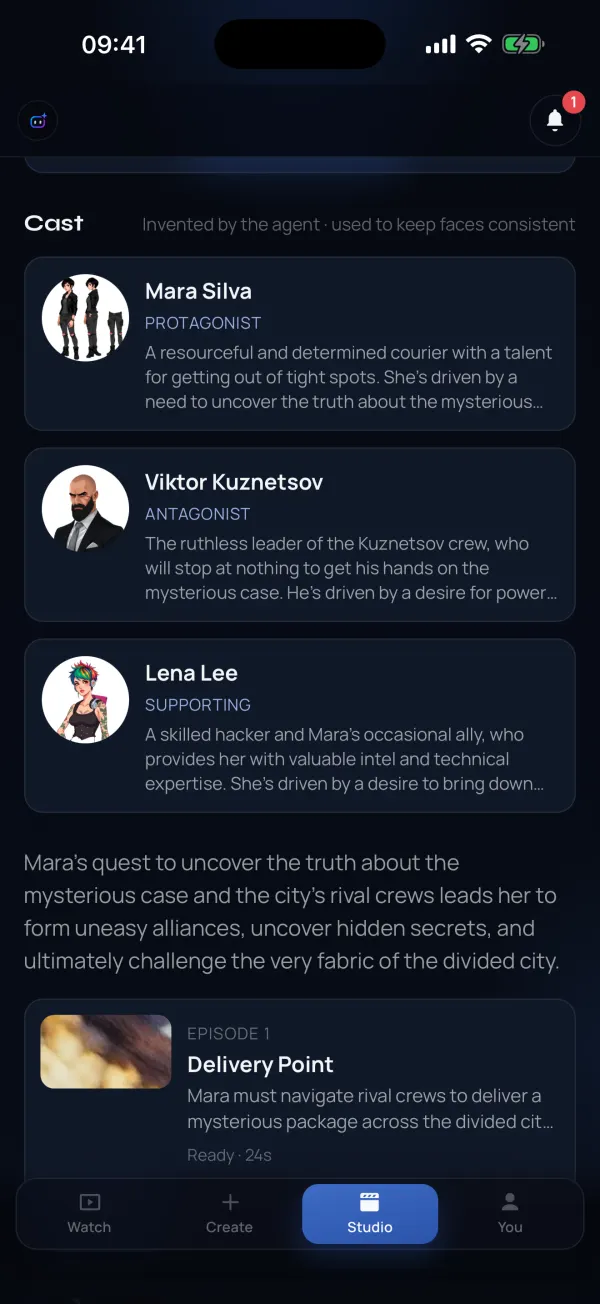
- Viktor (58): shaved head, grey beard, black turtleneck, a scar through the left eyebrow. He never raises his voice; he never has to.
- Lena (24): neon-green undercut, cracked phone held together with tape, talks faster than she types.
- Noa (19): round glasses, a uniform jacket covered in borrowed badges, a pencil behind each ear.
- Captain Welles (60s): silver hair combed back, medals worn polished but never mentioned.
Why AI needs the same discipline
When AI draws a character, vague words produce a different person every time. “An intimidating crime boss” could be anyone; “58, shaved head, grey beard, black turtleneck, scar through the left eyebrow” is one person. The same concrete details that help a reader help a model stay consistent.
That is why AISP writes every character’s appearance as a concrete description in the series bible, paints a reference portrait from it and reuses both in every scene. If you attach your own character notes when creating a series, they are treated as canon.
Words that help
- Build: wiry, broad-shouldered, stooped, compact, lanky.
- Hair: cropped, braided, shaved, silver-streaked, slicked back.
- Face: weathered, freckled, sharp-featured, round-cheeked, scarred.
- Clothing that tells a story: frayed cuffs, borrowed badges, a coat too thin for the weather.
- Movement: fidgets, looms, glides, limps, stands too close.
Questions
Should I describe a character all at once?
Give the first impression when they appear and add details later when they matter. Readers remember a few sharp details better than a paragraph.
How do I avoid clichés?
Replace generic words (beautiful, rugged, mysterious) with something specific the reader can see.
Product details checked November 2026. Rates and features can change; the app always shows the current cost before you confirm.