 AISP
What is a story premise? Meaning and 20 examples
A story premise is the basic situation the story grows from: a character, a world and a problem, usually framed as a “what if”. “What if a lighthouse was keeping something out instead of guiding ships in?” is a premise; the plot is what the keeper does about it.
Premise vs logline vs theme
- Premise: the starting situation or “what if”. It can be a single line.
- Logline: a one-sentence pitch with protagonist, goal, obstacle and hook.
- Theme: what the story is about underneath, such as grief, ambition or loyalty.
A premise comes first, a logline sharpens it, and the theme emerges as you write.
20 premise examples
- What if your phone’s autocorrect started finishing sentences you had not thought of yet?
- What if a town held an election every year to decide who must leave?
- What if the moon stopped in the sky for a week?
- What if a translator realised the alien delegation was lying — in perfect grammar?
- What if a retired assassin opened a bakery, and her first customer was a target she missed?
- What if every lie you told appeared as a bruise?
- What if a librarian could enter any book, but only once?
- What if two rival food trucks were the last businesses in a city after an evacuation?
- What if a ghost hired a living lawyer to sue her own family?
- What if a child’s imaginary friend went missing — and the police took the case?
- What if a robot built to grieve on behalf of others started grieving for itself?
- What if a football club owned by a village had to field its oldest residents?
- What if a city’s street signs changed every night, and only taxi drivers knew the new map?
- What if a wedding photographer kept capturing a stranger in every couple’s photos?
- What if a family could rewind one day a year, and they disagreed about which day?
- What if a farmer found that his scarecrow was keeping the crows from warning him?
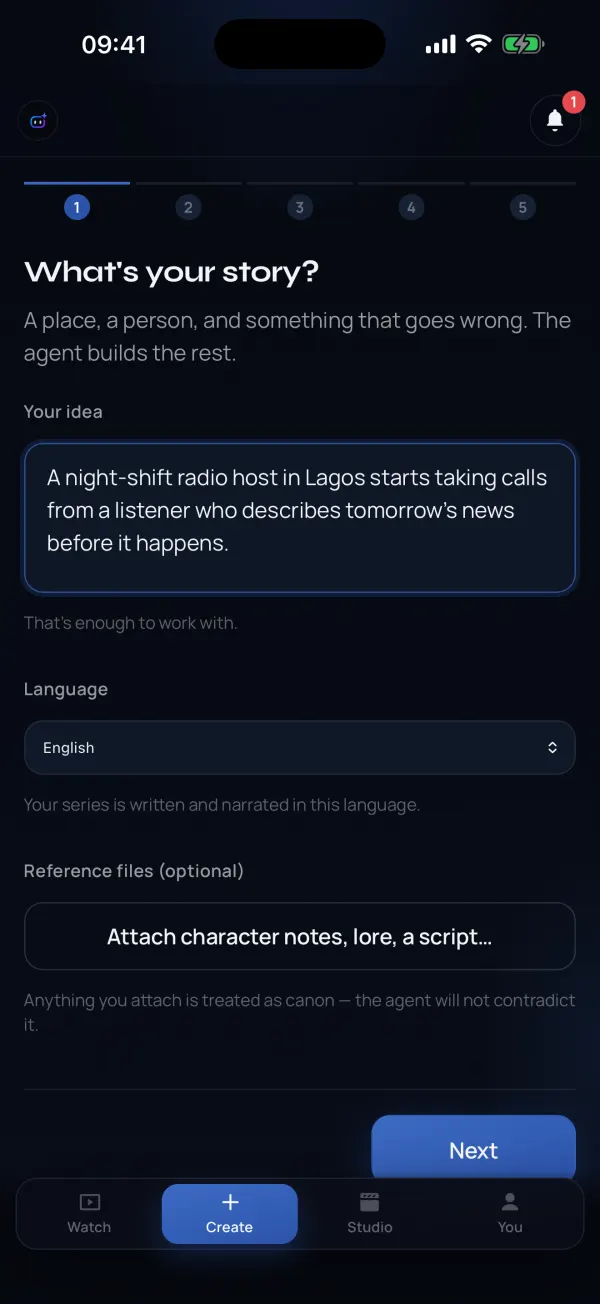
- What if a radio host took calls from a listener who knew tomorrow’s news?
- What if a heist crew had to return everything they ever stole within a week?
- What if a pilot landed a plane that took off fifty years ago?
- What if the last speaker of a language were a parrot?
Testing a premise
A strong premise suggests conflict on its own: you can see who would fight about it. It also suggests scenes. If you can picture five moments from the story straight away, it has legs. If it only suggests a mood, add a person with a problem.
Develop a premise into a series
Type a premise into AISP’s Create screen and the agent turns it into a series bible: a title, a cast with fixed appearances, world rules and a season outline, free. You can then render episodes as a storyboard, a narrated motion comic or video in 15 languages.
From premise to logline: one example
Premise: what if a lighthouse were keeping something out instead of guiding ships in? Logline: the last keeper on a drowned coast learns the light is a cage, and that the thing inside it knew her mother. The premise gives the idea; the logline adds a person, a stake and a hook.
Questions
Can a premise be a question?
Yes. “What if…” is the most common way to state a premise because it points straight at the story’s unusual element.
How many premises should I write before choosing?
Writers often draft ten or twenty quick premises and develop the two or three that suggest the most scenes.
Product details checked November 2026. Rates and features can change; the app always shows the current cost before you confirm.